
The Company's Biggest Security Hole Lived in the Breakroom
A recent security breach reveals how an internet-connected coffee machine can become a gateway for hackers to steal sensitive data, highlighting the hidden risks of IoT in corporate networks.
Key Points
- An internet-connected coffee machine caused a massive corporate data breach.
- The device used an ancient OS and default factory credentials.
- Hackers used the appliance to bypass firewalls and exfiltrate data.
- The incident highlights the dangers of ignoring IoT device security.
- Experts recommend isolating IoT devices and changing all default passwords.
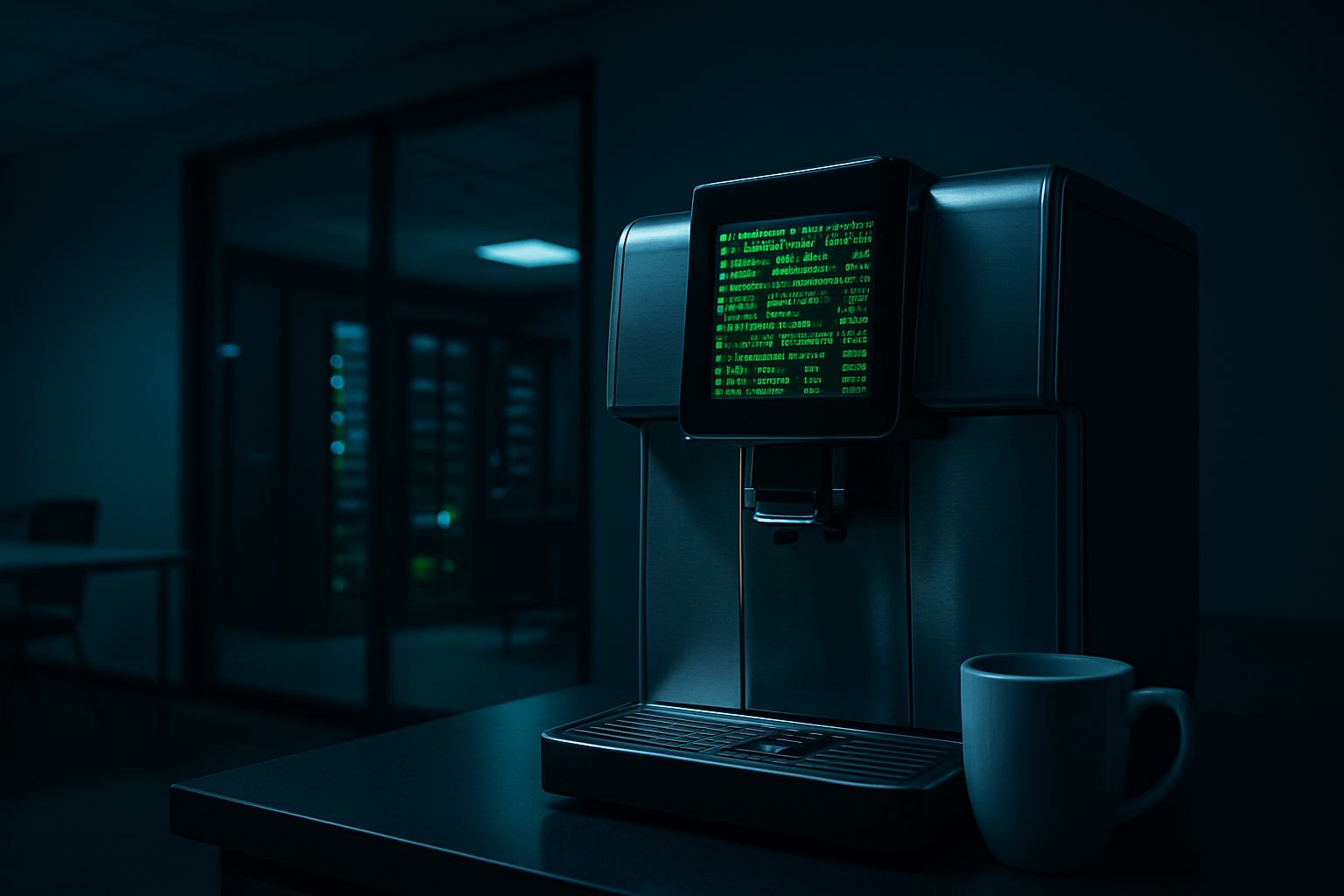
In the modern cybersecurity landscape, IT managers and network defenders spend a vast amount of time hardening servers, workstations, and cloud infrastructure against sophisticated Advanced Persistent Threats (APTs). However, a recent incident illustrates that the most dangerous security hole might not be an unpatched server or a phishing email, but something as mundane as a breakroom coffee machine. This story, brought to our attention by a veteran digital forensics investigator known as TR, serves as a stark reminder that even the most secure network is only as strong as its weakest connected device. TR, who boasts nearly two decades of experience in the field, was called in by a corporate client who feared that their server room had been breached by a rival entity. The company had suffered a massive data leak, and the executives were convinced that an sophisticated external actor had infiltrated their core systems. Instead of jumping to conclusions, TR and his team spent several days conducting a deep dive into the network's traffic, looking for malware, unauthorized access points, and hidden vulnerabilities. What they discovered was a surprise that defied traditional security expectations. The leak was not originating from a complex piece of malware or a compromised admin account; it was coming from an internet-connected coffee machine that had been placed on the company's secure internal network. The device, while capable of brewing a high-quality espresso, was a security nightmare. It was running an ancient, unpatched operating system, lacked any form of firewall protection, and, most critically, was still configured with its factory default password. Threat actors had identified this coffee maker as an easy entry point. By exploiting the default credentials and the lack of basic network security features on the appliance, they were able to pivot from the coffee machine into the broader network, effectively bypassing the client's expensive security measures. Every time an employee brewed a cup, the machine was silently exfiltrating data, sending packets to malicious actors located outside the country. It was a classic case of an 'own goal' in the world of information security. 'We needed to explain to the room that was full of vibrant executives that they had highly sensitive data that was compromised by a cappuccino,' TR recounted. This incident highlights the harsh reality that even the most sophisticated enterprise-grade firewall cannot protect a company when its kitchen appliances are actively communicating with the enemy. The incident serves as a poignant reminder that in a connected office, every single device is an endpoint that needs to be managed, monitored, and secured. This is far from an isolated incident. Merritt Maxim, VP and research director at Forrester Research, noted that this situation is eerily similar to a 2017 breach where hackers used a connected fish tank to compromise a North American casino. In that instance, the tank was supposedly isolated on its own network segment using a VPN, yet attackers still managed to exfiltrate 10 GB of data to a server in Finland. The lesson remains the same: connected devices are increasingly targeted because they are often ignored by IT security teams, lack proper monitoring, and are frequently assumed to be benign. Forrester data confirms that the proliferation of IoT devices is a major contributor to modern data breaches. These devices are rarely updated, often lack the capability for robust authentication, and are frequently left with default administrative credentials. To avoid falling victim to such breaches, companies must adopt a 'Zero Trust' approach. This means ensuring that any device—be it a printer, a smart light, or a coffee machine—is isolated from the main corporate network and that all default passwords are changed immediately upon deployment. Ultimately, the breakroom coffee machine incident is a call to action for every CISO and IT administrator. The perimeter is no longer just the firewall; it is every single connected point in the office. As we continue to integrate smart technology into our workspaces, we must not lose sight of the fundamental principles of security: change your defaults, segment your networks, and never assume that any device is harmless. Failure to do so might result in your most sensitive data being served up alongside a morning brew.
The Hidden Dangers of Corporate IoT
Internet of Things (IoT) devices have become ubiquitous in modern offices, yet they often lack the enterprise-grade security features found in traditional computing hardware. In this incident, a simple coffee machine became a bridge for attackers, highlighting the critical need for comprehensive asset management. Organizations must realize that every connected device represents an potential attack vector. Assuming that kitchen appliances or office peripherals are inherently safe is a strategic mistake that can lead to significant data loss, as demonstrated by both the coffee machine breach and the infamous 2017 casino fish tank hack.
Security Lessons for IT Professionals
The primary takeaway from this incident is the non-negotiable requirement to change default passwords and maintain regular firmware updates. Relying on factory settings is an open invitation for threat actors to exploit well-documented vulnerabilities. Security experts strongly advise implementing network segmentation. By placing IoT devices on a restricted sub-network, companies can ensure that if one device is compromised, the attackers cannot pivot into the core infrastructure where sensitive data resides.
This article was drafted with AI assistance and editorially reviewed before publication. Sources are listed below.
